Hear ye, hear ye!
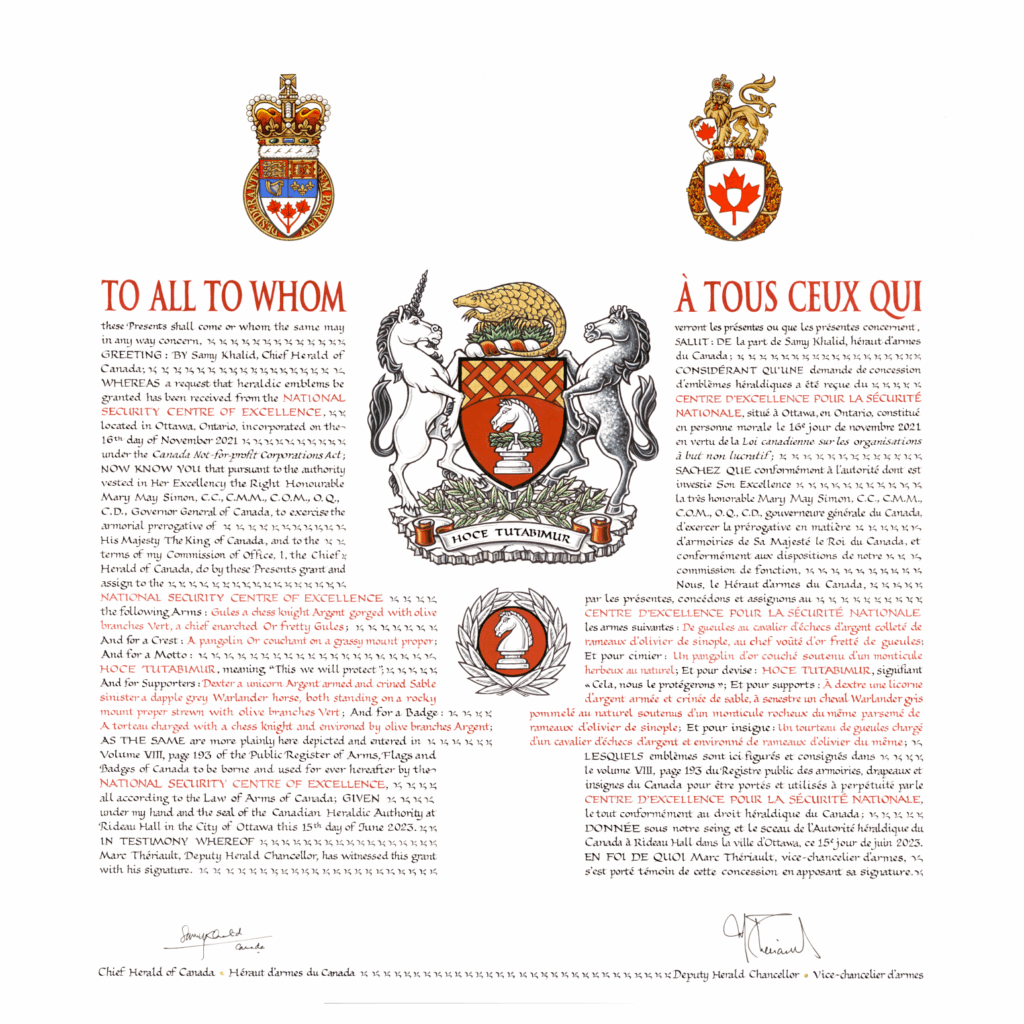
Proclamation of the granting of arms
Proclamation ceremonies originated in the Middle Ages, when they were used to publicize laws and decrees, and to officialize royal acts.
The granting of Arms is a national honour in Canada. What began with the authority of Queen Elizabeth II late 2021, the Centre’s official heraldry was granted by His Majesty King Charles III of England, via Canada’s Governor General and Canada’s Chief Herald of the Governor General’s Canadian Heraldic Authority in 2023, symbolizes the NSCOESN’s commitment to safeguarding Canada’s national security.
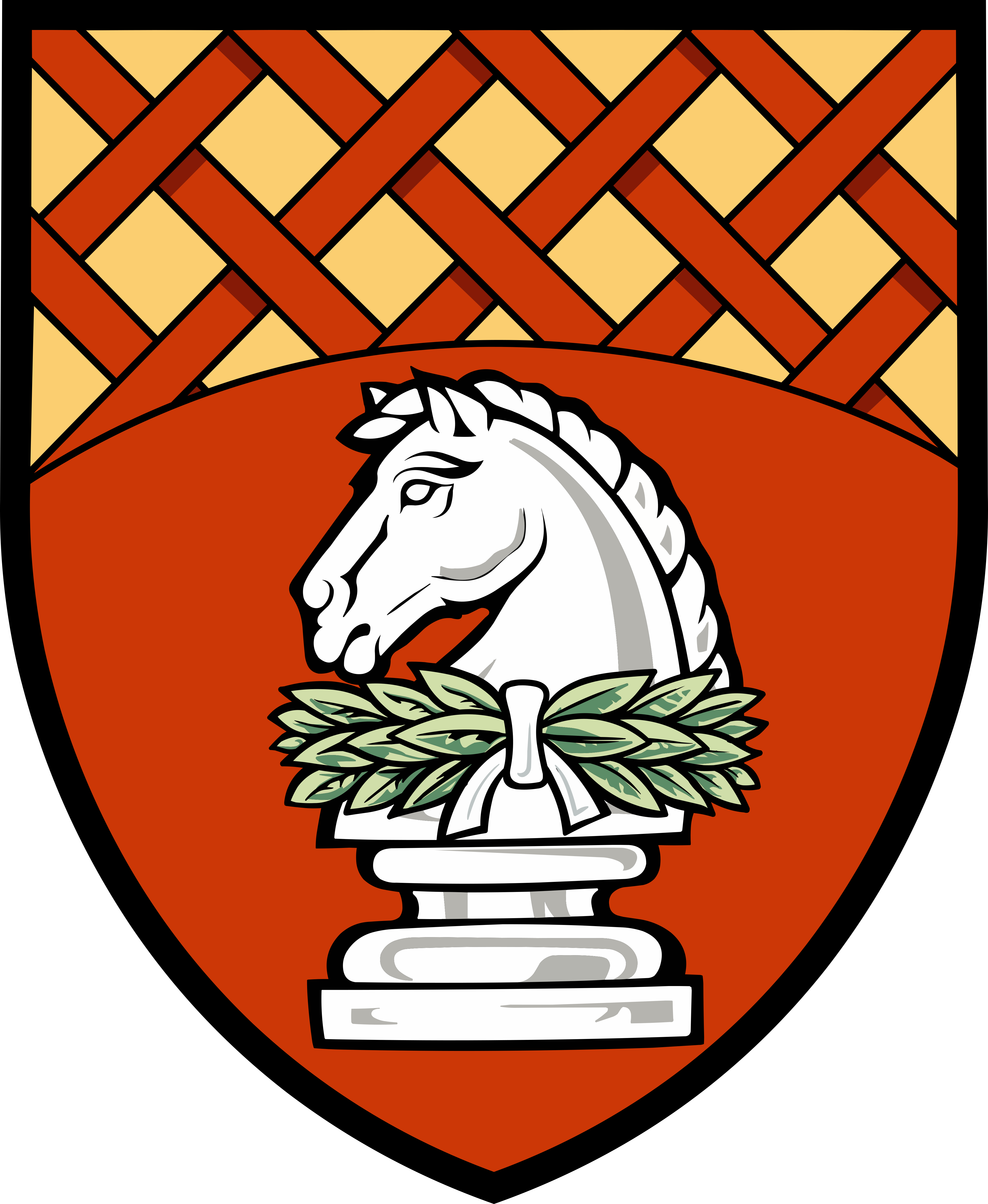
At its core is a shield featuring a white knight chess piece—representing strategic defence—flanked by olive branches that reflect the Centre’s dedication to peace, international cooperation, and the rule of law. A gold upper band signifies excellence and the protective “umbrella” the Centre provides to Canada’s critical interests.




Above the shield stands a pangolin, chosen for its distinctive natural armour and its ability to defend and counter threats—mirroring the Centre’s dual mission of protection and proactive response. The supporters, a unicorn and a war-horse, embody resilience and readiness, standing together on a rocky base adorned with olive branches symbolizing international law.
The assigned motto Hoce Tutabimur—“This we will protect”—captures the Centre’s guiding purpose: to help defend Canada and strengthen the institutions that contribute to national resilience.
Descriptions written by the Governor General’s Canadian Heraldic Authority are included here, and remain “forever” with the Governor General office, visible at their website.
Blazon
Gules a chess knight Argent gorged with olive branches Vert, a chief enarched Or fretty Gules;
Symbolism
Red and white are the colours of Canada, which the Centre is sworn to protect from security risks, while gold symbolizes excellence. The curved chief alludes to an umbrella, showcasing how the centre’s activities protect the country. The interwoven red bands represent the technological measures implemented to protect from cyber-attacks. The knight chess piece, which can strike in unexpected ways on a chessboard, evokes the strategic dimension of the Centre’s advice to Canadian government departments and organizations. The olive branch symbolizes international law.
Blazon
A pangolin Or couchant on a grassy mount proper;
Symbolism
The pangolin is an animal that combines defensive and offensive attributes to protect itself from its adversaries, since it is covered with armour-like scales composed of small sharp blades. This represents the Centre’s dual mission of helping Canadian entities to mount suitable defences to external attacks, while also enabling them to proactively counter threats to national security.

Blazon
Dexter a unicorn Argent armed and crined Sable sinister a dapple grey Warlander horse, both standing on a rocky mount proper strewn with olive branches Vert;
Symbolism
The unicorn has traditionally been described as a fierce creature that is difficult to catch, while its horn was thought to have protective powers, since it could detect and nullify the effects of poison. This alludes to the Centre’s resolve in defending Canadian interests and enabling Canadian organizations and entities to evade external threats.
Blazon
Dexter a unicorn Argent armed and crined Sable sinister a dapple grey Warlander horse, both standing on a rocky mount proper strewn with olive branches Vert;
Symbolism
The Warlander is a horse recognized as one of the closest descendants of the medieval destriers used in warfare. The two supporters thus symbolize the duality of the Centre’s action: defensive (the unicorn) and offensive (the Warlander). The olive branches repeat the symbolism of the Arms.